Transfiguration and Hiroshima
Brighter Than the Sun

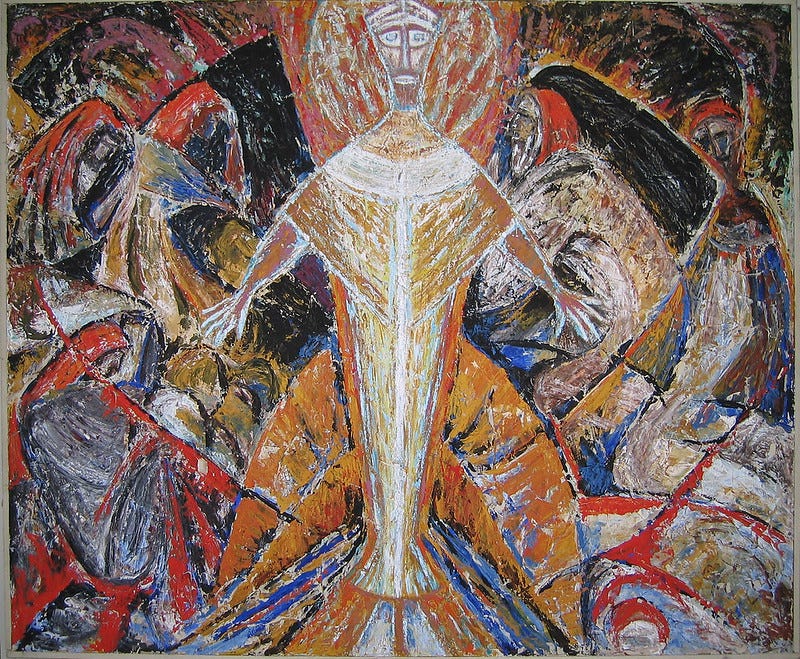
Transfiguration by Libuse Lukas Miller
Today is the Feast of the Transfiguration. It is also the 81st anniversary of the atomic bomb dropped on Hiroshima, Japan, on August 6, 1945.
Matthew the Evangelist describes the Light of Tabor like this: “And Jesus was transfigured before them, and his face shone like the sun.” (Matthew 17:2)
Those who experienced the atomic bomb in Hiroshima and lived to tell about it all described it in the same words: It began with a flash brighter than the sun.
The atomic bomb dropped on Hiroshima was humanity’s first use of a weapon of true mass destruction—a city-annihilating weapon. In the Japanese seaport city of 250,000 people, 100,000 were either killed instantly or doomed to die within a few hours. Another 100,000 were injured. Of the city’s 150 doctors, 65 were killed and most of the surviving doctors were injured. Of the 1,780 nurses, 1,654 were either dead or too badly injured to work. Hiroshima had become the house of the dead and dying. On the church calendar it was Transfiguration Day.
When Jesus was transfigured on Mount Tabor his face shone like the sun; and when he came down the mountain a little boy was healed—a boy who had been thrown into fire and water by a demon.
When “Little Boy” (the innocuous name given to the monstrous bomb) shone like the sun over Hiroshima, a demon was let loose and thousands of little boys and girls were burned in atomic fire and poisoned by radioactive rain. The bombing of Hiroshima is the anti-Transfiguration—a macabre and demonic parody of the Transfiguration.
The Transfiguration was a turning point in Jesus’ ministry.
Hiroshima was a turning point in human history.
Selah.
When I was thirteen I read John Hersey’s Hiroshima—a 31,000-word essay originally published in The New Yorker magazine. In May of 1946 The New Yorker sent Hersey, a Pulitzer Prize winning journalist, to Hiroshima to report on what happened in the wake of the atomic bomb. Hersey tells the story through the eyes of six survivors. A Catholic priest, a Methodist pastor, a Red Cross doctor, a private practice doctor, an office girl, and a tailor’s widow.
Originally Hersey’s essay was to be published in monthly installments, but on August 31, 1946 the entire issue of The New Yorker consisted solely of the Hiroshima essay. It sold out in two hours. Albert Einstein ordered a thousand copies. A few months later it was published as a book and over three million copies were sold. John Hersey’s reporting was instrumental in changing the way Americans viewed the bombings of Hiroshima and Nagasaki.
When I first read Hiroshima in 1972 I knew I was reading of an unspeakable evil. I knew that Auschwitz and Hiroshima were to be spoken of in the same breath. The ovens of Auschwitz and the mushroom cloud over Hiroshima were produced by the same intention: Mass killing on an industrial scale. Science had created a deadly scythe capable of cutting down millions in a single stroke. I knew this was an insidious evil—a hideous strength. How could I not know this?
In Hiroshima I read of people with charred skin and melted eyes. I read of fires burning with such fury that they created windstorms. I read of black radioactive rain. I read of how when those in their thirst-crazed desperation drank of this radioactive rainwater they doomed themselves to an agonizing death. I read of hell on earth—there is no other way to describe it. Dante could not have dreamt of greater horrors. At thirteen I knew there was no justification for inflicting this kind of suffering and death upon anyone—much less upon hundreds of thousands of civilian men, women, and children. Yes, at thirteen I knew this was evil.
But by the time I was thirty I had learned how to justify the unjustifiable. I was now a pastor. A preacher. A zealous Christian. A spiritual leader. And I had learned how to justify inflicting hell on other humans in the name of war. The Japanese were the enemy and the bomb was pragmatic. Sadly, my thirteen-year-old moral instincts were more Christlike than my thirty-year-old callous nationalism. Though I knew the text of the Bible far better at thirty than at thirteen, this had not prevented a moral regression. I had learned how to use the Bible to silence my teenage conscience and endorse my thirty-something rationalization. But “using” the Bible like that is a tragic trick we play on ourselves. If we know how to do it just right, we can make the Bible endorse anything . . . even Hiroshima.
Eventually though, in my forties, I began to encounter Jesus all over again. I discovered the “unvarnished Jesus” and gained new eyes. I was born again . . . again. The Bible had not changed, but I had changed. I was beginning to read the Bible in a new way. Ironically, it was closer to the way I read the Bible when I was teenager. I knew again what I had once known long ago: Bombing cities and the inevitable death of innocent people this causes is incompatible with the way of Jesus. (For that matter it’s even incompatible with so-called “Just War Theory.”) Having been born again again in midlife I knew once again that no matter how you spin it, the Jesus of the Gospels would never bless the bombings of Hiroshima and Nagasaki. Never!
(Please read A Song for Nagasaki.)
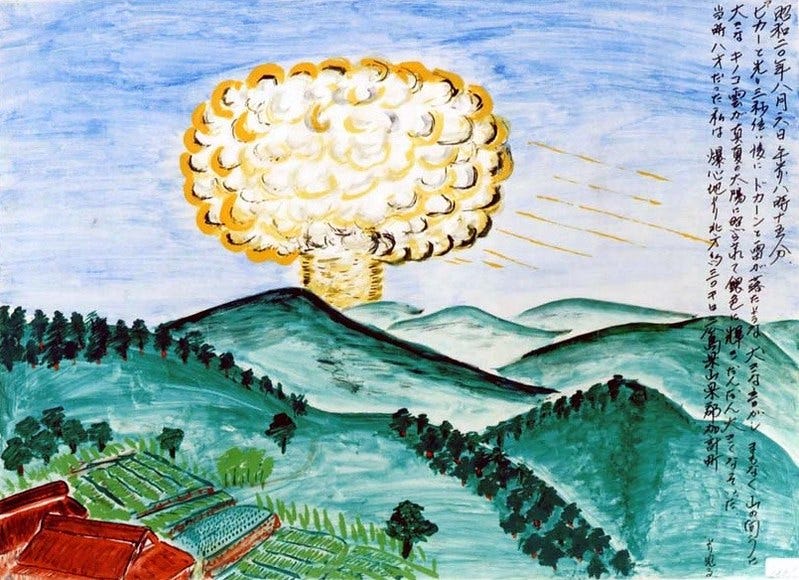
Mushroom-Shaped Cloud by Susumu Horikoshi, age 6, August 1945
The face shining brighter than the sun that saves the world is not “Little Boy” over Hiroshima or “Fat Man” over Nagasaki, but the Son of Man shining over Tabor. When Jesus was transfigured, God spoke from heaven and said, “This is my beloved Son in whom I am well pleased; listen to him!” Jesus is what God has to say.
Presidents can justify as due vengeance the atomic bomb dropped on Hiroshima [please do watch this!] . . . but Jesus is what God has to say.
Militarists can concoct arguments to rationalize killing 200,000 civilians with two bombs . . . but Jesus is what God has to say.
Biblicists can point to alleged God-sanctioned killing in the Old Testament . . . but Jesus is what God has to say.
Dispensationalists with their dark “end time” fantasies can fetishize war . . . but Jesus is what God has to say.
And what does Jesus say? He says this . . .
Love your enemies!
Do good to those who hate you.
Bless those who curse you.
Pray for those who hurt you.
Love your enemies!
Do good to them.
Then your reward from heaven will be very great.
You will be acting like children of the Most High.
For he is kind to the ungrateful and the evil.
Be merciful, just as your Father is merciful.
(Luke 6:27–28; 35–36)
Transfiguration and Hiroshima—remembered on the same day.
Transfiguration and Anti-Transfiguration. Which one will we bless? Which one will we lament?
I have repented of ever justifying the Anti-Transfiguration of Hiroshima.
Long ago I returned to listening to the truly Transfigured Christ.
Because . . .
Jesus is what God has to say.
BZ
P.S. Robert Oppenheimer as a tortured soul in 1965. Oppenheimer, the brilliant scientist and father of the atomic bomb, when he witnessed the first atomic detonation at Los Alamos on July 16, 1945, uttered these prophetic and poignant words from the Bhagavad Gita: “Now I am become Death, the destroyer of worlds.” Lord, have mercy.
O God, who on the holy mount revealed to chosen witnesses your well-beloved Son, wonderfully transfigured, in raiment white and glistening: Mercifully grant that we, being delivered from the disquietude of this world, may by faith behold the King in his beauty; who with you, O Father, and you, O Holy Spirit, lives and reigns, one God, for ever and ever. Amen
–The Book of Common Prayer (Collect for the Feast of Transfiguration)
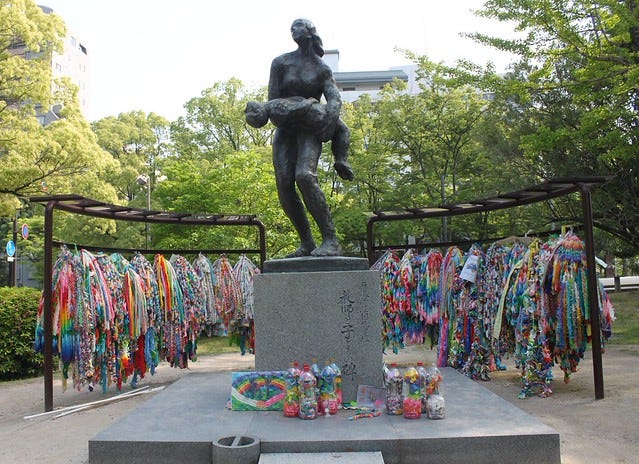
Teacher and Child, Hiroshima Peace Park
Brian, this was a hard read, but necessary. I had never put the two days together.
I’ve watched the program World War II with Tom Hanks. The discussion of Hiroshima and Nagasaki was chilling, rationalized as dropping the bombs prevented more U.S. deaths in war. Lord have mercy. Lord grant peaceful, humble hearts to all humans, and may we all feel compelled to practice peace and humility at all times in all situations. My U.S. Navy father visited Japan in the weeks after the bombings. He was haunted. Lord have mercy.