One Final Post of "The Reverend"
The Complete Short Story and Audio Performance

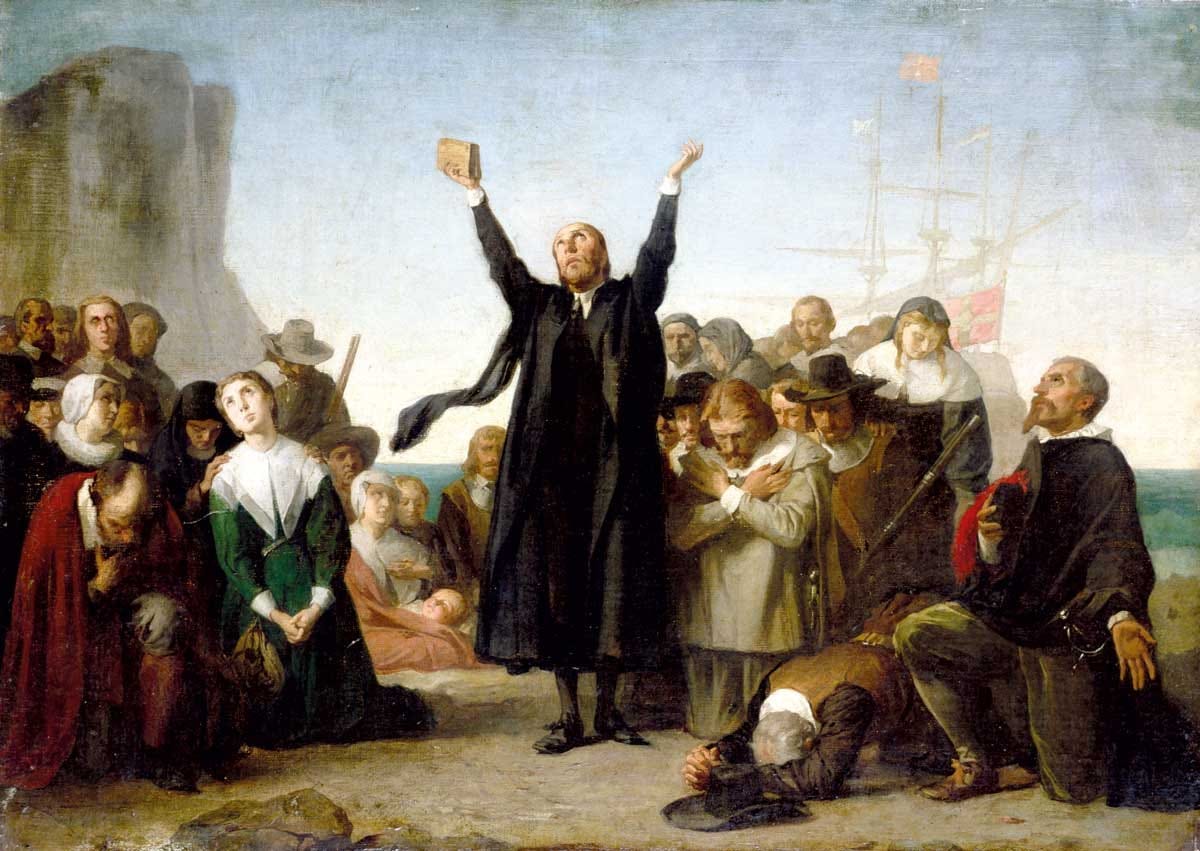
For those who have asked for The Reverend in a single post, here it is.
The Reverend
A Fantasy
I
In the last hour of his long dying the Reverend drifted back in memory. The venerable old minister was slowly succumbing to a weeks-long fever in his sixty-seventh year. His wife and six of their ten children gathered around his bedside as they softly sang the Twenty-Third psalm.
Yea, though I walk through the valley of the shadow of death, I will fear no evil.
In his slow retreat out of this world a parade of memories conjured many a reminiscence. He remembered his childhood and the days of his youth in Leicester, England. He remembered his wedding day and his ordination. He remembered the birth of his children. He remembered the two they had buried.
But most of all he remembered his last sixteen years in the New World. He remembered the misery of seasickness during the two-month voyage from Southampton. He remembered the blessed mercy of finally being on terra firma.
He remembered arriving at the Connecticut River Colony in May of 1636. The river was the Missi-Tuk estuary, and the colony consisted of a few hundred English Puritans who had come to the New World to build a New Jerusalem.
He remembered his first year as the River Colony’s minister. With Puritan zeal the Reverend had thrown himself into his pastoral duties of preaching, teaching, counseling, and baptizing. Finally free from the tyranny of the Church of England they would be a people holy to the Lord. In their Canaan Land they were free to practice a pure religion uncorrupted by the idolatrous papists of the Old World. The Reverend was proud to be a Puritan pioneer building this new city upon a hill.
Most of all he remembered a solitary night a full year after his arrival in the New World. It was the night of May 25, 1637—and the Reverend had spent the whole night in prayer.
On the western bank of the Missi-Tuk was the Pequot village of Siccanemos—home to nearly a thousand souls. Of course these were heathen souls, souls of the damned. And that was the issue to be resolved. What was to be done about these thousand heathen souls in the new Promised Land? The Captain favored a military solution and proposed a surprise attack at dawn the next morning. Ninety soldiers were already armed with muskets and steel rapiers, prepared to launch the assault.
But a few of the colonists had expressed misgivings about an unprovoked war upon their Pequot neighbors. One colonist even had the temerity to ask, “Why should we be so furious? Should not Christians have more mercy and compassion?” To resolve the matter the question was presented to the Reverend—the spiritual leader of the colony. He solemnly answered, “I will spend the night in prayer, and place the question before the Almighty.”
Yes, the dying Reverend remembered the long night of prayer.
He sat in the plain, sturdy, timber meetinghouse all night, all alone, with an open Bible in his lap. He prayed,
“Oh, Lord, what shall be done with the heathen in this Thy Promised Land?”
As he waited in silence in the wee hours of the morning, it was the words of Samuel that finally came to him.
“Thus saith the Lord of hosts, go and smite Amalek, and utterly destroy all that they have, and spare them not; but slay both man and woman, infant and suckling.”
“Yes, Lord. Thy will be done. Amen.”
The answer had come. It was right there in the Scriptures. It was clear what was to be done. They must do as the Israelites had done. The Puritan Elect must cleanse the Promised Land of the heathen Canaanites. The idolators would not share in the inheritance of the just. As Scripture says, “the dwelling place of the wicked shall come to naught.” Just before dawn, the Reverend went to the Captain and said,
“I have spent the night with God in prayer and I am fully satisfied with your proposal. God has given us clear title and direct command to possess the Promised Land. And to those who would raise questions about Christian mercy and compassion, I would refer them to the Scriptures. Sometimes God declares that even women and children must perish with the heathen. We have sufficient light from the Word of God for our proceedings. As did Joshua, and King Saul, and King David in their holy wars of old, even so go forth now unto the battle; vanquish the heathen, doubting nothing. Strengthen your resolve with the words of Moses: ‘The Lord is a man of war.’”
The Reverend remembered these words as he was dying.
And he remembered the sharp report of musket fire, the screams of the heathen, the smell of smoke, and how the God of Israel arose in holy wrath against the Pequots on that misty spring morning.
In little more than an hour the Pequot village was burned to the ground and six hundred heathen Indians were killed—some shot, some pierced, some burned to death. True, the English lost two men—but perhaps they were not among the Elect. The ways of the Lord are mysterious.
During the next few days the remaining Pequot survivors—grieving and homeless—were easily found and destroyed. The Puritan triumph over the pagan tribe was total. God be praised!
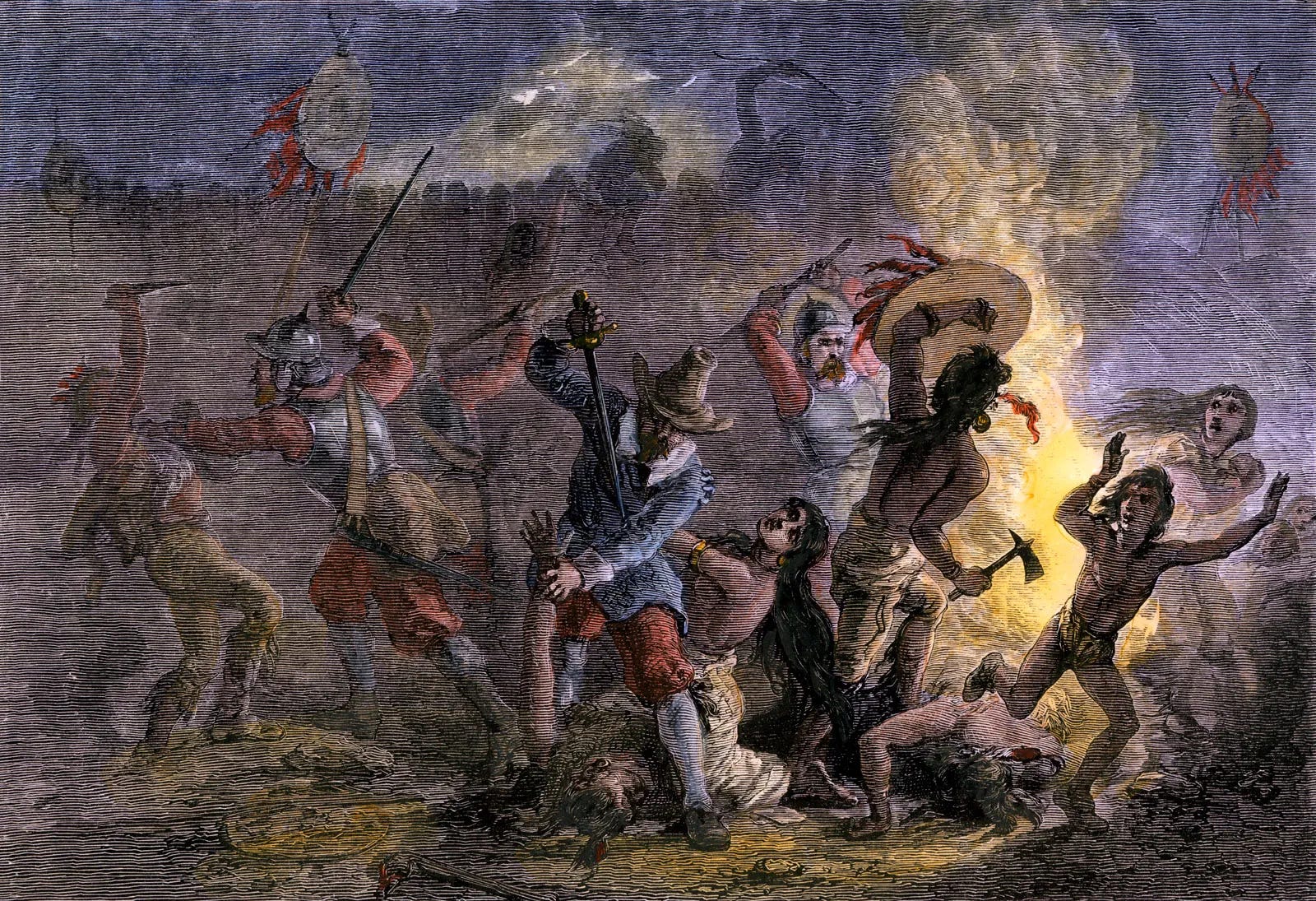
Throughout New England the news of the conquest of the Pequot was celebrated. Hallelujahs resounded on the lips of the Elect across the New Promised Land. And now in his dying hour the Reverend remembered the sermon he preached to his jubilant congregation four days after the battle. He was particularly eloquent on that Lord’s Day. From his pulpit the preacher thundered,
“Thus was God seen in his mount, crushing his proud enemies, and the enemies of his people! Yea, burning them up in the fire of his wrath, and dunging the ground with their flesh! It was the Lord’s doing, and it was marvelous in our eyes.”
There was many a hearty “Amen!” from the men in the congregation. Inspired, the Reverend improvised a line not in his manuscript.
“Praise be to God that on that day we sent six hundred heathen souls to hell!”
This was the sermon, and this was the sentence the dying Reverend remembered in his final moments. He remembered all of this while those around his bed tenderly sang,
Surely goodness and mercy shall follow me all the days of my life, and I will dwell in the house of the Lord forever.
Then the end came, the moment of death. A slow fading into darkness, an enfolding darkness, a sweet darkness; there was no pain, only darkness; like a heavy, warm blanket. And thus the Reverend passed from this world into the next . . .
. . . . . . .
LIGHT!
Suddenly all was Light! There was nothing but Light. Searing pure white Light, a million times brighter than a bolt of lightning. The Light pierced the Reverend. The Light blinded him.
Light and Darkness were now the same. He could see nothing. All was Light. All was Darkness. He waited in the Light-Dark. Maybe for a minute, maybe for a millennium. Time had no meaning, no measurement. All existed in the fixed singularity of a Light-Dark Now.
Eventually though, there began to be a gradual change in the static singularity of the Light-Dark—either the Light had dimmed or the Reverend’s eyes had adjusted to the Light. He was beginning to see—at first ghostly, and then more clearly.
He perceived that he was standing in the corner of a small rectangular room; a room with white walls, a white floor, and a white ceiling. There was no door, there were no windows. He saw he was wearing the black suit he knew he would be buried in. There was no one else in the room.
Yet there was one lone solitary object in the room with the Reverend. In the very center stood an oval mirror in a bronze frame about five feet tall. For a reason he could not articulate he felt a dread foreboding about the mirror; he didn’t like it; it felt ominous and threatening. He backed further into the corner.
Time had resumed. The Reverend stood in the corner of the white room wearing his black burial suit for a few more minutes not knowing where he was or what he should do. Eventually he thought he might try saying something.
“Hello?”
Silence.
But then there came a commanding Voice from nowhere and everywhere.
“Know thyself.”
The Reverend understood what this meant. He didn’t like it, but he obeyed. Hesitantly he approached the menacing mirror in the center of the room, stood before it, and looked upon his reflection.
He didn’t see a man of sixty-seven in his burial suit. He saw a man of fifty-two in a clerical robe standing in a pulpit. The Reverend in the mirror held his Bible aloft and roared,
“Praise be to God that on that day we sent six hundred heathen souls to hell!”
A moment later the unseen Voice thundered.
“I never knew you. Depart from me.”
Suddenly the Reverend was seized by a violent, invisible, terrifying force and hurled from the Light into a distant Darkness . . . and in the Darkness the Reverend passed into oblivion.
. . . . . . .

II
The Reverend awoke. He was lying on the ground. It was cold and damp, and the air smelled of smoke. Looking around, he saw that he was in a small clearing in a dense forest. The smoke was coming from the smoldering ruins of what seemed to be burnt wigwams. Remnants of charred blankets lay on the ground. Broken pottery shards littered the clearing. He struggled to his feet. It was twilight and difficult to see anything clearly. Somehow he intuited that it was not just before sunrise, but sometime after sunset. It would be dark soon.
Slowly he began to walk around the clearing. In the smoky air there was an acrid stench. At the far end of the clearing he saw something else smoldering, something he couldn’t identify. The Reverend moved closer. Then he saw what it was. It was a pile of burnt corpses—maybe twenty. Some were very small—the blackened bodies of babies. Maggots crawled out of the eye sockets of one of the skulls. The Reverend jumped back in horror, wretched, and then ran into the woods.
The woods were thick, it was hard to see. He tripped many times, but somehow never fell. In blind terror he ran and ran—maybe a hundred yards, maybe a mile, maybe a marathon. Just when he felt he could run no more, he came into a clearing and bent over breathing heavily, relieved to be out of the woods and away from the burnt village. Suddenly his relief was shattered when he realized he was back where he had started. He was in the same clearing with the same burnt wigwams and the same hideous pile of smoldering corpses.
The Reverend stumbled back into the woods. For hours he wandered among the trees, but no matter how resolutely he attempted to walk in one direction away from the dreadful clearing, his course always brought him back to the same burnt village. Every attempt to depart the awful place only led back to it. Strangely, although hours surely must have passed, it was still twilight. It never grew any darker or any lighter. No matter how much time passed it remained the gloom of twilight just before total Darkness.
The Reverend was exhausted and decided he would try to rest in the woods—he couldn’t bear to stay in the burnt village. He walked a hundred paces or so into the woods, selected a fallen tree to sit upon . . . and to his horror he discovered that he could not sit down! No matter how hard he tried, he could not sit, he could not lie down, he could not fall—an invisible force restrained him. He could only walk or stand in the woods. The Reverend felt no hunger, was slightly thirsty, and only a little bit cold; but he was so terribly tired. He was utterly exhausted and had to rest, but he could not—not in these woods, it was impossible to sit or to lie down. His legs ached.
Then he remembered that when he awoke in the clearing, he had been lying on the ground. With a resignation brought on by an unbearable weariness he retraced his steps back to the clearing, went as far away as possible from the smoldering pile of corpses, laid down on the cold, damp ground, and slept.
This was the Reverend’s fate for . . . how long? There was no telling. It was always twilight. He was never hungry, though a little cold and thirsty, but always so terribly tired. The wigwams, blankets, and corpses were always smoldering. Would their smoke rise forever? Now and then he could sleep, but there were no dreams—only the brief oblivion of total Darkness. When he did sleep, and this was not often, the Reverend never knew how long he slept. Maybe a moment, maybe a month. It made no difference. He always awoke in the same place, in the same twilight, utterly exhausted with the same weariness.
The woods that surrounded the clearing and imprisoned the Reverend were lifeless. No birds, no beasts, no butterflies—no life of any kind. Just an endless forest in the gloom of twilight. For a long time he persisted in trying to escape by walking through the woods as straight and far as possible, but after an hour or so he always arrived back at the same accursed place.
The Reverend wasn’t lost, he was entombed. He was a prisoner. No matter how hard he tried, he could not escape the burnt village. He didn’t need to do anything to survive. He didn’t need to eat or drink—though he was always thirsty. He didn’t need to fashion shelter—he was cold, but he would not freeze. He was so very tired, but he would not—could not!—die of exhaustion.
But by far the worst torment was that he was all alone. He was condemned to bear his misery by himself. In the first days (months? years?) this did not occur to the Reverend because he was so overwhelmed with panic and obsessed with escape. Yet as all hope of escape was finally abandoned, his chief torment was the soul-crushing loneliness. Sometimes in his despair he would wail,
“Am I here all alone? Is anyone out there? Please! Someone help me!”
The only answer was silence.
. . . . . . .
III

The Reverend was sitting in the edge of the clearing thinking about nothing; he was only enduring the passing of time. How much time had passed he had no idea. The emptiness was endless, cold as the clay. Perhaps the angel in the Apocalypse had already issued his dread oath: “There shall be time no longer.”
Late one evening—for it was always late in the evening—out of the corner of his eye he sensed movement. With a start he looked to his left and saw something entering the clearing from the woods. It was an Indian woman.
In all his long internment in the twilight the Reverend had encountered no living thing, much less another human being. The Indian woman was small and wore a fringed buckskin dress decorated with blue and red geometric designs. Her hair was in braids, and she wore a necklace made of shells. The Reverend jumped to his feet as the woman calmly approached him. There was something unusual about her appearance. At first glance she looked to be a woman of about sixty with deep wrinkles and grey-streaked braids, but a moment later she was a young woman, under thirty, with smooth skin and dark black braids. In the twilight of the camp the images of an old and young Indian woman floated in and out of one another. The woman was now standing only a few feet from the Reverend. He stammered,
“Wh-who are you?”
“I am the help you need.”
“Wh-where did you come from?”
“I came from the Light.”
“From the Light?”
“Yes, from the Light.”
“Where is the Light?”
“The Light is where you need to be but cannot yet go because you are a prisoner of the Darkness.”
“I don’t understand.”
“There are many things you do not understand.”
“Why have you come?”
“I was sent from the Light to help you.”
“Who sent you?”
“The Light sent me to you.”
“Do you know me?”
“I know you are the Reverend.”
“Who are you?”
“I am the one sent to bring you the help you need. I am the sister you have not yet met. I am a friend you do not yet know. I am your guide.”
“What is your name?”
“My name is Kwanita. In your tongue it means God-Is-Gracious.”
“God? Do you know about God?”
Kwanita paused, looked for a long time at the Reverend and then said,
“Let us sit.”
They both sat down—Kwanita upon the ground, the Reverend on a log. Then he repeated his question:
“What do you know about God?”
“God is the Creator, the Great Spirit; and the Great Spirit is gracious.”
“Who is the Great Spirit?”
“The Eternal One who is Light and in whom there is no Darkness at all.”
“That comes from the Bible. So you are a Christian?”
“I am a Pequot.”
The Reverend look at Kwanita through narrowed eyes and said coldly,
“Then you are a heathen, and you do not know the true God.”
Kwanita did not respond to the Reverend, and they sat in silence for several minutes.
Finally he asked the question that mattered most to him:
“Do you know the way out of this place?”
“Yes.”
“Can you show me the way out?”
“Yes. I am your guide. But it will be hard for you. I can show you the way, but it will be hard for you to follow me.”
“That doesn’t matter, I’m ready to go now.”
“I do not think you are ready.”
“I’m ready right now,” said the Reverend sharply.
“Why do you think you are ready?” asked the Indian woman.
“I’m ready to leave this place because I belong to the Elect. There has been a mistake; I do not belong here.”
“Yes. You do belong to the Elect,” she agreed.
“Then I’m ready to leave. Lead me away from here.”
“You are not ready.”
The Reverend shouted at the woman, “I’m ready right now! Show me the way!”
Kwanita regarded the Reverend for a few moments with a sad look, and then stood to her feet and without a word walked into the woods. The Reverend jumped up to follow her, but once in the woods he found it hard to keep up with Kwanita and he was slowly losing sight of her.
“Wait! Slow down! Don’t leave me!” shouted the Reverend.
But the woman just kept walking until the Reverend could see her no more. He stood still, shouted for her to come back a few times, and then dejectedly returned to his detestable twilit prison camp.
. . . . . . .
Because there was never a sunset or sunrise, and because nothing ever happened in the clearing or in the woods, it was nearly impossible to gauge time, but after what must have been a very long passage of time, the Indian woman called Kwanita returned and again sat by the Reverend. He said,
“Why did you leave me behind? Why won’t you help me?”
“I will help you,” she said, “but you cannot yet follow me. You cannot leave until you are ready to learn. When you are ready to learn, then I will help you, then I will guide you.”
The Reverend folded his arms across his chest and said,
“What do I need to learn then?”
“You need to learn many things. And first of all you need to learn who you are.”
“I know who I am,” he snapped angrily, “I’m the Reverend. I’m a Christian. I’m of the Elect. And I should not be here. I know I have died, and I should now be in heaven.”
“Then why are you here?” Kwanita asked softly.
The Reverend sighed deeply, cocked his head sideways, and said,
“I don’t know.”
“When you were in the Light what did the mirror show you?”
“It showed a reflection of myself preaching a sermon.”
“What were you preaching?
“I was preaching the Word of God. My text was Psalm twenty-one, verse nine. ‘Thou shalt make them as a fiery oven in the time of thine anger: the Lord shall swallow them up in his wrath, and the fire shall devour them.’”
“What did you say in your sermon?”
“I said, ‘Thus was God seen in his mount, crushing his proud enemies, and the enemies of his people! Yea, burning them up in the fire of his wrath, and dunging the ground with their flesh! It was the Lord’s doing, and it was marvelous in our eyes.’”
She turned away from the Reverend, looked for a long time at the burnt village, and then asked,
“Do you still believe that? Do you believe the death and misery that your people brought to my people was good? Do you believe it was of the Light?”
The Reverend stared hard at the Indian woman and said,
“Yes. It was ordained by God. I spent the night in prayer and God spoke these words of Holy Scripture to me: ‘Thus saith the Lord of hosts, go and smite Amalek, and utterly destroy all that they have, and spare them not; but slay both man and woman, infant and suckling.’ First Samuel chapter fifteen, verse three.”
The Indian woman looked at the Reverend for a long time and then whispered,
“We do not know those words in the Light.”
“That’s because you’re a heathen and you don’t know the Bible. You are among the damned and I belong to the Elect.”
“You do belong to the Elect,” she said with a sad smile. “And my people were damned—damned by you and your people.”
“You were damned by God,” said the Reverend.
Kwanita stood up without a word and walked into the woods. Again the Reverend tried to follow her, and again he could not keep up with his guide, and eventually she disappeared out of sight. He returned to the clearing, sat down, and muttered to himself, “I know I’m right. The Bible says so.”
. . . . . . .
The Reverend lost track of how many times Kwanita visited him, but the visits always ended the same way: She would leave, the Reverend would try to follow her . . . and fail. Now the Indian woman was back again.
“You need to learn,” she said. “The Voice in the Light said, ‘Know thyself.’ When you looked in the mirror, what did you see?”
“I already told you. I saw myself preaching.”
“What did you say? What were the exact words spoken by your image in the mirror?”
The Reverend thought for a moment and then said, “Praise be to God that on that day we sent six hundred heathen souls to hell!”
“Are those true words? Did you and your people send us to hell?”
“Yes, because you are heathens, and you are damned.”
She stood up to leave, but then stopped, turned to the Reverend and said,
“In the pile of burnt bodies you see over there were two of my grandchildren—they were babies. Did they go to hell?”
“Yes,” said the Reverend. “The great theologian Augustine of Hippo taught us that unbaptized babies share the common misery of the damned.”
Kwanita asked, “Do you still believe we are the damned and you are the Elect?”
“Yes,” said the Reverend.
“But you are here. You are in the place that you and your people made. And you cannot leave it.”
The Reverend said nothing.
Finally the woman said,
“You are right about one thing. We did go to hell. You and your people brought hell to us. You tried to build your heaven on our hell. This is the place you helped create. But I did not stay here, I came to the Light. All who live by the truth come to the Light.”
“Truth? I’ve always lived by the truth!” the Reverend barked. “I believe in the truth of the Word of God. We did what we did by the light of Scripture.”
Kwanita replied, “If you say you are of the Light, but do the works of darkness, you tell lies to yourself. If you tell yourself too many lies, you become a Lie. The Great Spirit does not know a Lie.”
“I am of the Light. I am of the Elect.”
“Your words are empty words. If you say you are of the Light, but hate is in your heart, you are in the Darkness. If you love, you will live in the Light. But the light that is in you is Darkness, and the Darkness has made you blind. Whoever hates his brother or sister is a murderer, and a murderer cannot come into the Light. You led your people into the Darkness. You followed the Evil One. There is no truth in that one. He is a murderer from the beginning. He does not abide in the truth. He is a liar and the father of lies.”
“We had light from the Word of God,” the Reverend replied in a flat monotone. “In Deuteronomy the Bible says, ‘When the Lord thy God shall bring thee into the land whither thou goest to possess it, and hath cast out many nations before thee, and when the Lord thy God shall deliver them before thee; thou shalt smite them, and utterly destroy them; thou shalt make no covenant with them, nor shew mercy unto them.’ That’s the Word of God and we cannot change it.”
“We do not know those words in the Light,” Kwanita said.
The Reverend would not look at the Indian woman as he replied, “It’s in the Bible.”
“I am going to leave now,” she said, “but before I go, I want to tell you the most important thing we know in the Light. Love is from the Great Spirit. The Great Spirit is Love. Those who do not love, do not know the Great Spirit. The Great Spirit loves us, so we must love one another. If we do not love, we can never see the Great Spirit. Whoever loves, abides in the Great Spirit, and the Great Spirit abides in him. There is no fear in Love. Perfect Love casts out all fear. If anyone says they love the Great Spirit, but hates their brother or sister, this one is a liar. If we cannot love the brother or sister we see, we cannot love the Great Spirit who we cannot see. The Great Spirit is Light. The Great Spirit is Love.”
“Those words are almost like words from the Bible,” the Reverend said.
“Those words are from the Light,” Kwanita replied, and walked into the woods.
The Reverend only half-heartedly tried to follow the Indian woman. He knew he would fail to keep up with his guide, and he was right.
. . . . . . .
IV
The Reverend waited a long time for the woman to return. When at last she did, he said,
“I’ve been here by myself for a long time, and I’ve thought about some things. I admit I made some mistakes. I’ve learned my lesson. I’m ready to leave now. Please show me the way out.”
“What was your . . . mistake?” Kwanita asked.
“I should have first preached the gospel to your people and given your tribe a chance to repent. I was too rash.”
She shook her head slowly and then said,
“Your words are not plain words. What you mean is you should have preached to us before you killed us. You would have preached, and we would have died. You have learned nothing yet. You speak much about the Elect and the damned. You call your people Elect and my people damned. You are very proud. You say you know the Light, but you do not walk in the Light. The Great Spirit shows no partiality to the nations. Everyone who fears the Great Spirit and does what is right is accepted by him. The Great Spirit sent his Son into the world to save the world, not to condemn it. Your words are condemning words, not saving words. They are words of Darkness, not words of Light. If you use your Holy Book to hate, you can never come into the Light. Eternal life is found in Light and Love. You must learn this.”
The Reverend closed his eyes and said,
“Alright. I’ve learned it. I’m sorry. I’ve been punished enough. Please show me the way out.”
“Do you think you are being punished?”
“Yes. I’ve been punished for my mistakes. Now, I beg you, show me the way out of here!”
She stood up and said,
“Punishment is not why you are here. You can come into the Light when you can come into the Light. When you can love, you will walk in the Light.”
Then Kwanita turned and disappeared into the woods. For the first time the Reverend did not try to follow the Indian woman.
. . . . . . .
The Reverend thought about the words that Kwanita had spoken to him for a very long time—for she did not return for a very long time. He could not say how long. There was nothing for the Reverend to do but to wait in the smoky twilight of the burnt Pequot village and ponder. He no longer tried to leave the clearing; he just sat and thought about what the Indian woman had said about Light and Love. Light and Love. Light and Love . . .

. . . . . . .
After an eon (or was it really only an instant?) Kwanita returned to the clearing, and when she did the Reverend said nothing to her. The Pequot and the Puritan sat in silence for a long time. At last the Reverend said softly,
“Tell me how you died.”
“A man called the Captain shot me with a musket.”
She turned her head and pointed to her right temple. There was a small, round white scar on her tawny skin.
“I’ve never noticed that before,” the Reverend said and winced.
“It is now only a very small scar,” she whispered. “It no longer causes me pain. Even the memory of it brings me no pain. In the Light there is no more pain, no more sorrow, no more crying, no more death. The former things have passed away. All things are made well now. I wear the scar like I wear my necklace of shells. It is part of my story; it is part of who I am. I am a Pequot woman who lived and died and came into the Light. Now all is Love. All things lost are made good again.”
Kwanita leaned closer and peered into the Reverend’s eyes and said,
“For me there is no pain in my scar; but I can see it causes you pain.”
It was true. When the Reverend looked at the small white scar on her right temple, he felt a sharp pain in his own right temple. He tried to avoid looking at that part of her face. Again they sat in silence for a long time.
At last the Reverend asked, “Why do you keep coming to me?”
“I have told you, the Light sent me to you.”
“So you have to come to me,” the Reverend said, as he lowered his eyes.
“No. I do not have to come to you. The Light asked me if I wanted to help you, and I said I would like to try. And the Light said, ‘Go to him.’”
“I’m in hell, aren’t I?” said the Reverend.
“You are here. You are in the bitter memory of the place that was once the village of my people. You are in the place you helped to make. You and your people tore a hole in the Light and made Darkness and now you are in it. You have fallen into the pit that you have dug. You are stranded on the edge of the outer Darkness.
“I’m damned.”
“Yes, you are,” she said sadly.
The Reverend was quiet for a long while and then said,
“You once told me that I belong to the Elect, but now you agree that I am damned.”
“I also told you there are many things you do not understand. You are elect. You are damned. There is a you that is elect. There is a you that is damned. There is a you that is known. There is a you that is unknown. To leave this place you must find the you that is elect. You must find the you that is known by the Light.”
“I don’t know how to do that,” he moaned, and for the first time since coming to the endless twilight the Reverend wept. Kwanita touched him gently on the shoulder and then slipped into the woods.
This time the Reverend despaired of ever seeing Kwanita again, or of ever leaving the awful place in the interminable twilight.
. . . . . . .
Eventually though the Indian woman did return. She said nothing; she just sat with the Reverend in her usual place. They sat in silence for a long time. Finally the Reverend spoke and said,
“Tell me again what your name means.”
“In the Pequot tongue Kwanita means God-Is-Gracious.”
“God was gracious,” the Reverend replied bitterly.
“God is gracious,” she insisted.
For an even longer time the Pequot and the Puritan sat together in silence.
“Kwanita, I need to tell you something.”
It was the first time the Reverend had addressed her by name. The Indian woman who looked both old and young, now looked mostly young. She said nothing but looked steadily at the Reverend. He heaved a big sigh and said,
“I was wrong. I was proud. I was stupid. That night I spent in prayer I was convinced that God wanted my people to kill your people. I believed it because I wanted to believe it. And I made the Bible say what I wanted to believe. I made God in my own image. I wanted to believe that I and my people were elect, and that you and your people were damned. Heathens. Savages. But that was not true. We were the savages. We were the murderers. What we did was evil. What I did was evil.”
Kwanita listened silently and said nothing.
The Reverend continued,
“When I was in the Light, the man I saw in the mirror was telling lies. I was a lie. I am not a Reverend; I am only a great sinner. When I said, ‘Praise be to God that on that day we sent six hundred heathen souls to hell!’—that was a lie, that was a great sin. We did not send six hundred heathen souls to hell. I sent my own soul to hell.”
The Reverend turned toward Kwanita and said,
“I cannot undo the evil I helped create, all I can do is ask you to forgive me . . . if you can.”
After a moment, Kwanita said,
“I can forgive you; I do forgive you; I have forgiven you. And there is One who can undo all the evils that sin has caused. The Great Spirit sent his Son into the world to save the world. The Light of the world will restore all things. The Great Spirit is willing that none should perish. The Light is gracious. But we must come to the Light in the way of truth.”
Then Kwanita stood to her feet, lifted her hands, looked toward the sky, and began to pray in the Pequot language.
Kiyawun wámi wucshák Manto, qá yaqi nákum mus kuputukimun.
The Reverend did not understand her words, but her prayer said this:
“We all come from God, and to him we will return.”
She prayed like this for a long time. When Kwanita ended her prayer, she looked at the Reverend and said,
“I think you are ready to leave this place. Follow me. I will be your guide.”
The Reverend, crying softly, said,
“I cannot. I’ve tried so many times before, and no matter how hard I try, I cannot follow you.”
“You are now ready,” Kwanita said, and walked toward the woods.
The Reverend followed her without a word. And this time he was able to follow his guide for a very long way—much farther than ever before. But eventually he began to falter and fall behind his guide—the distance between Kwanita and the Reverend kept increasing. He called out to her to slow down, to wait, but she never spoke, she never slowed, she never turned; she just kept walking until, as every other time, she disappeared into the distance.
. . . . . . .
The Reverend was utterly devastated. Undone. He could not follow his guide. He knew this had been his last chance and now with the disappearance of Kwanita every trace of hope had vanished. He stood in the dark forest utterly alone and wept bitterly. Through his tears he wrenched a mournful prayer from the very depths of his tortured soul:
“God, be merciful to me a sinner.”
. . . . . . .
More time passed—it seemed an immense amount of time. And then . . . he thought he saw something. A tiny speck of silver Light far, far away in the gloomy forest. A tiny shining diamond in the vast dark distance.
He was so tired, wearier than he had ever been, but he began to move toward the pinpoint of Light. And very slowly, almost imperceptibly, the tiny Light grew a little bit brighter, a little bit larger, a little bit closer.
Through his unimaginable weariness the Reverend pressed on. He had never walked so far. It felt like he walked a thousand miles through the dark forest, always moving toward the small patch of Light he could see in front of him.
The past was receding. Every step took him further from the black hole that had held him for so long. He kept going—always moving toward the Light that grew steadily brighter and larger.
. . . . . . .
The Reverend was now a pilgrim, not a Puritan pilgrim, but a true pilgrim. He was a pilgrim pressing on toward the Light. His long journey was a pilgrimage of the soul.
The Reverend remembered a verse from the book of Proverbs.
“The path of the just is as the shining light, that shineth more and more unto the perfect day.”
This verse became his refrain, his song of ascents. He repeated it over and over—“the Light shineth more and more unto the perfect day.”
. . . . . . .
At last, after his long struggle through the shadowy forest, after his long pilgrimage away from the black hole on the edge of the outer Darkness . . . the Reverend finally reached the edge of the Light.
His peregrination of salvation was nearly complete. He needed only to take one final step.
He stood at the threshold of the Light. He could see nothing in the Light. All was brightness and blinding Light. The Reverend prayed one more time,
“God, be merciful to me a sinner.”
With that he took a deep breath and stepped into the Light.
For an instant there was nothing but pure Light and sheer silence.
And then a great and melodious Voice spoke.
“I know you. Welcome home.”
The End.

Thank you for this story Brian. It has had a similar impact on me as “The Great Divorce” by Lewis. Powerful and prophetic.
Thank you Brian, such a wonderful tale packed with meaning.