The Reverend
A Fantasy | Part I

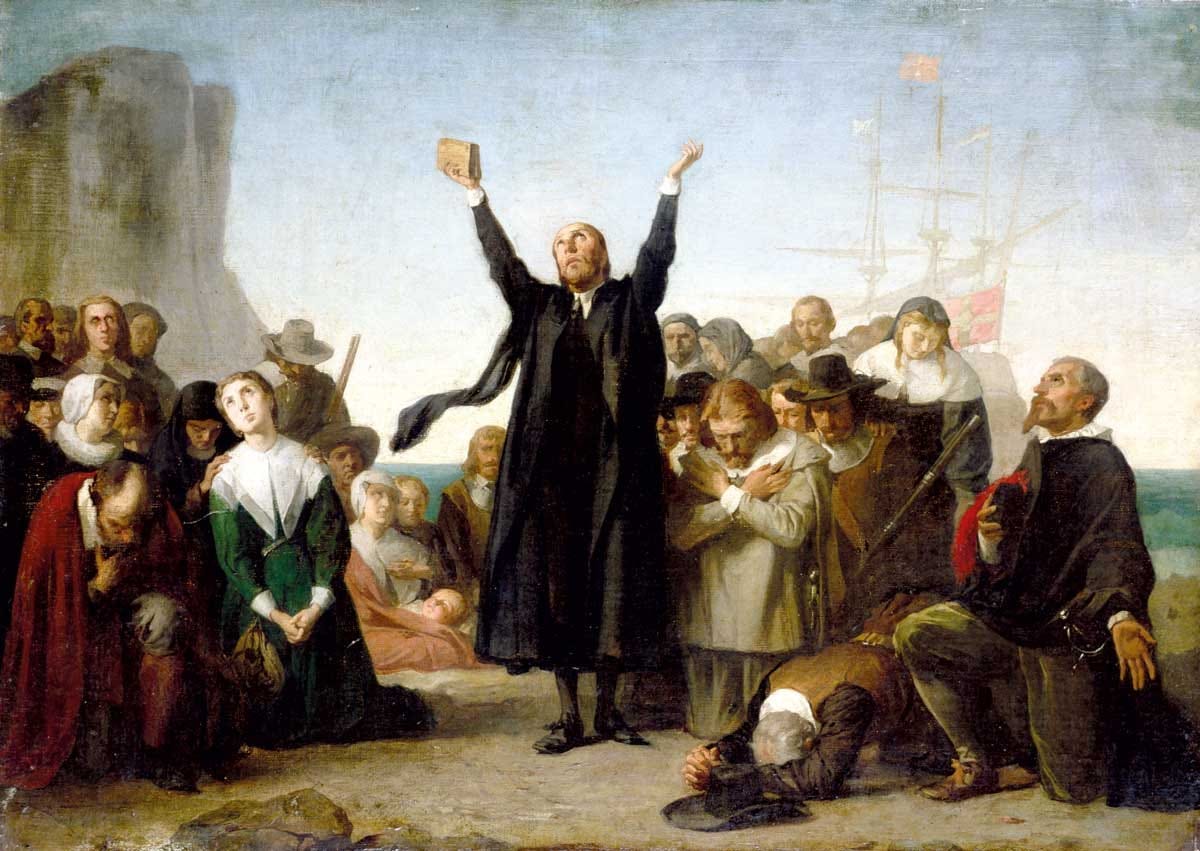
Yesterday my most recent book, Unseen Existences, was released. Originally it was to consist of ten chapters and a “Fantasy”—a concluding piece of fiction related to the preceding chapters. Unfortunately the book does not have the Fantasy—it seems it made the publisher nervous. So, trusting that you are a less nervous reader, I will publish it here over the next four weeks.
What follows is a flight of fancy that entered my imagination nearly fully formed while on a long solo hike in the Rocky Mountains in the summer of 2024. It was inspired in part from the writings of N. Scott Momaday—the highly acclaimed Native American (Kiowa) novelist, essayist, and Poet Laureate.
Though this tale’s connection to Unseen Existences (and especially chapter nine,“Depart from Me”) will be readily apparent, I ask the reader to keep in mind the genre I have ascribed to this bit of writing—fantasy.
This is not doctrine or dogma or even theology per se, it is a fantasy. A fantasy with a point, to be sure, but a fantasy, nonetheless. After all, what do any of us know with certainty regarding judgment and the afterlife? With that in mind, let us begin.
The Reverend
A Fantasy
I
In the last hour of his long dying the Reverend drifted back in memory. The venerable old minister was slowly succumbing to a weeks-long fever in his sixty-seventh year. His wife and six of their ten children gathered around his bedside as they softly sang the Twenty-Third psalm.
Yea, though I walk through the valley of the shadow of death, I will fear no evil.
In his slow retreat out of this world a parade of memories conjured many a reminiscence. He remembered his childhood and the days of his youth in Leicester, England. He remembered his wedding day and his ordination. He remembered the birth of his children. He remembered the two they had buried.
But most of all he remembered his last sixteen years in the New World. He remembered the misery of seasickness during the two-month voyage from Southampton. He remembered the blessed mercy of finally being on terra firma.
He remembered arriving at the Connecticut River Colony in May of 1636. The river was the Missi-Tuk estuary, and the colony consisted of a few hundred English Puritans who had come to the New World to build a New Jerusalem.
He remembered his first year as the River Colony’s minister. With Puritan zeal the Reverend had thrown himself into his pastoral duties of preaching, teaching, counseling, and baptizing. Finally free from the tyranny of the Church of England they would be a people holy to the Lord. In their Canaan Land they were free to practice a pure religion uncorrupted by the idolatrous papists of the Old World. The Reverend was proud to be a Puritan pioneer building this new city upon a hill.
Most of all he remembered a solitary night a full year after his arrival in the New World. It was the night of May 25, 1637—and the Reverend had spent the whole night in prayer.
On the western bank of the Missi-Tuk was the Pequot village of Siccanemos—home to nearly a thousand souls. Of course these were heathen souls, souls of the damned. And that was the issue to be resolved. What was to be done about these thousand heathen souls in the new Promised Land? The Captain favored a military solution and proposed a surprise attack at dawn the next morning. Ninety soldiers were already armed with muskets and steel rapiers, prepared to launch the assault.
But a few of the colonists had expressed misgivings about an unprovoked war upon their Pequot neighbors. One colonist even had the temerity to ask, “Why should we be so furious? Should not Christians have more mercy and compassion?” To resolve the matter the question was presented to the Reverend—the spiritual leader of the colony. He solemnly answered, “I will spend the night in prayer, and place the question before the Almighty.”
Yes, the dying Reverend remembered the long night of prayer.
He sat in the plain, sturdy, timber meetinghouse all night, all alone, with an open Bible in his lap. He prayed,
“Oh, Lord, what shall be done with the heathen in this Thy Promised Land?”
As he waited in silence in the wee hours of the morning, it was the words of Samuel that finally came to him.
“Thus saith the Lord of hosts, go and smite Amalek, and utterly destroy all that they have, and spare them not; but slay both man and woman, infant and suckling.”
“Yes, Lord. Thy will be done. Amen.”
The answer had come. It was right there in the Scriptures. It was clear what was to be done. They must do as the Israelites had done. The Puritan Elect must cleanse the Promised Land of the heathen Canaanites. The idolators would not share in the inheritance of the just. As Scripture says, “the dwelling place of the wicked shall come to naught.” Just before dawn, the Reverend went to the Captain and said,
“I have spent the night with God in prayer and I am fully satisfied with your proposal. God has given us clear title and direct command to possess the Promised Land. And to those who would raise questions about Christian mercy and compassion, I would refer them to the Scriptures. Sometimes God declares that even women and children must perish with the heathen. We have sufficient light from the Word of God for our proceedings. As did Joshua, and King Saul, and King David in their holy wars of old, even so go forth now unto the battle; vanquish the heathen, doubting nothing. Strengthen your resolve with the words of Moses: ‘The Lord is a man of war.’”
The Reverend remembered these words as he was dying.
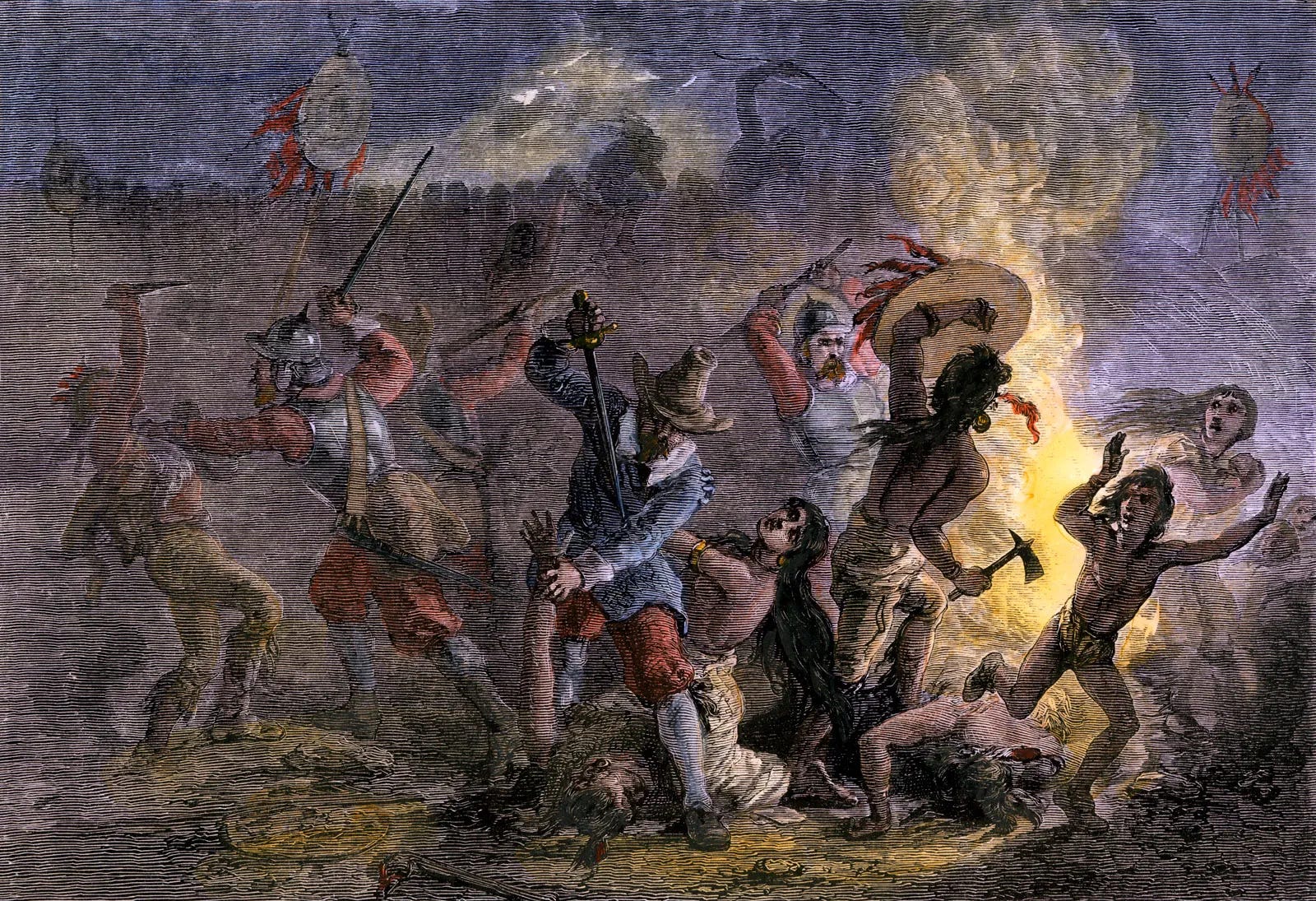
And he remembered the sharp report of musket fire, the screams of the heathen, the smell of smoke, and how the God of Israel arose in holy wrath against the Pequots on that misty spring morning.
In little more than an hour the Pequot village was burned to the ground and six hundred heathen Indians were killed—some shot, some pierced, some burned to death. True, the English lost two men—but perhaps they were not among the Elect. The ways of the Lord are mysterious.
During the next few days the remaining Pequot survivors—grieving and homeless—were easily found and destroyed. The Puritan triumph over the pagan tribe was total. God be praised!
Throughout New England the news of the conquest of the Pequot was celebrated. Hallelujahs resounded on the lips of the Elect across the New Promised Land. And now in his dying hour the Reverend remembered the sermon he preached to his jubilant congregation four days after the battle. He was particularly eloquent on that Lord’s Day. From his pulpit the preacher thundered,
“Thus was God seen in his mount, crushing his proud enemies, and the enemies of his people! Yea, burning them up in the fire of his wrath, and dunging the ground with their flesh! It was the Lord’s doing, and it was marvelous in our eyes.”
There was many a hearty “Amen!” from the men in the congregation. Inspired, the Reverend improvised a line not in his manuscript.
“Praise be to God that on that day we sent six hundred heathen souls to hell!”
This was the sermon, and this was the sentence the dying Reverend remembered in his final moments. He remembered all of this while those around his bed tenderly sang,
Surely goodness and mercy shall follow me all the days of my life, and I will dwell in the house of the Lord forever.
Then the end came, the moment of death. A slow fading into darkness, an enfolding darkness, a sweet darkness; there was no pain, only darkness; like a heavy, warm blanket. And thus the Reverend passed from this world into the next . . .
. . . . . . .
LIGHT!
Suddenly all was Light! There was nothing but Light. Searing pure white Light, a million times brighter than a bolt of lightning. The Light pierced the Reverend. The Light blinded him.
Light and Darkness were now the same. He could see nothing. All was Light. All was Darkness. He waited in the Light-Dark. Maybe for a minute, maybe for a millennium. Time had no meaning, no measurement. All existed in the fixed singularity of a Light-Dark Now.
Eventually though, there began to be a gradual change in the static singularity of the Light-Dark—either the Light had dimmed or the Reverend’s eyes had adjusted to the Light. He was beginning to see—at first ghostly, and then more clearly.
He perceived that he was standing in the corner of a small rectangular room; a room with white walls, a white floor, and a white ceiling. There was no door, there were no windows. He saw he was wearing the black suit he knew he would be buried in. There was no one else in the room.
Yet there was one lone solitary object in the room with the Reverend. In the very center stood an oval mirror in a bronze frame about five feet tall. For a reason he could not articulate he felt a dread foreboding about the mirror; he didn’t like it; it felt ominous and threatening. He backed further into the corner.
Time had resumed. The Reverend stood in the corner of the white room wearing his black burial suit for a few more minutes not knowing where he was or what he should do. Eventually he thought he might try saying something.
“Hello?”
Silence.
But then there came a commanding Voice from nowhere and everywhere.
“Know thyself.”
The Reverend understood what this meant. He didn’t like it, but he obeyed. Hesitantly he approached the menacing mirror in the center of the room, stood before it, and looked upon his reflection.
He didn’t see a man of sixty-seven in his burial suit. He saw a man of fifty-two in a clerical robe standing in a pulpit. The Reverend in the mirror held his Bible aloft and roared,
“Praise be to God that on that day we sent six hundred heathen souls to hell!”
A moment later the unseen Voice thundered.
“I never knew you. Depart from me.”
Suddenly the Reverend was seized by a violent, invisible, terrifying force and hurled from the Light into a distant Darkness . . . and in the Darkness the Reverend passed into oblivion.
~To be continued . . .
Needs to be its own book. It’s really good. No one is doing this kind of work. It’s important Brian. Go for it. Beyond The Veil - please write it!
Thank you for this, Brian. For the guts to write it, the candor, and your prophetic heart that shines through it. Looking forward to the rest of this chapter - and maybe for more fantasy and other fiction from you!