The Blessed Ethos
A Christian Culture Must Pass the Beatitude Test

The historic creeds of the church are more or less adequate in providing the parameters for orthodoxy. (Actual heresy almost always has to do with an error in Christology.) But orthodoxy isn’t everything, there’s also ethos—the characteristic spirit of a culture. Ethos has to do with the vibe, the tone, the tenor, the mood, the feel, the ineffable atmosphere of a particular culture or community. Religious and political movements all have an ethos—a communal spirit, if you will.
Of late, in certain circles, there has arisen an emphasis on a muscular and manly Christianity. Alright, knock yourself out—be as muscular and manly as you like. Just remember that any culture that calls itself Christian must pass the Beatitudes test. The ethos of a culture claiming to be Christian must vibe comfortably with the Beatitudes. This is non-negotiable.
The Beatitudes (Matthew 5:1–12) are the eight-fold proclamation by Jesus regarding those best-situated to receive the arrival of the kingdom of God as good news. Jesus identified the blessed souls who will welcome the heavenly kingdom as...

     The Dispirited
     The Mournful
     The Meek
     The Justice-craving
     The Merciful
     The Pure-hearted
     The Peacemakers
     The Persecuted

Conversely, the rich and powerful, the content and comfortable, the proud and self-assured tended to regard the gospel of the kingdom of God, not as good news, but as a threat—a threat to their status, power, and wealth. After all, it was those in the upper echelons of economics, politics, and religion that conspired to kill the miracle-working prophet from Galilee who had suddenly burst onto the scene and amassed a large following. From the moment Jesus gave the Beatitudes on a mountainside in Galilee, he was on a trajectory that would lead to Calvary. The Beatitudes find their fullest expression in the cross.
We can think of the Beatitudes as the preface to the Sermon on the Mount—the preamble to the constitution of the kingdom of God. When Jesus of Nazareth stepped onto the public stage by forgiving sinners, healing the sick, casting out demons, and preaching good news to the poor, the kingdom of God had drawn near. (Jesus is the kingdom of God in person!) In his proclamation of an arriving kingdom, Jesus was offering those who would believe the good news and were willing to rethink everything an invitation to enter into God’s alternative society—a society not from Rome but from heaven.
And the kingdom of heaven has a distinct ethos—an ethos very different from the spirit that characterized the power and might of imperial Rome. The Rome of the Caesars was certainly masculine and manly, but it was also arrogant and cruel—it was, in fact, antichrist. After the crucifixion and resurrection of Jesus the world would have to choose between two alternatives: Caesar or Christ. Both held the title Lord. Both were called the savior the world. Both offered a promise of peace. Both claimed to be an eternal kingdom. But only one could be the Christ—the other could only be antichrist.
Indeed Rome and Christ make similar claims in their gospels, but they each have a very different and distinct ethos. The ethos of empire (ancient and modern) is beastly and cruel. The ethos of Christ is humane and lamb-like. Jesus is Daniel’s Son of Man who follows in the wake of the four beasts, and he is Revelation’s Lamb who triumphs over the Beast. So do not confuse being manly with being beastly; and do not mistake being lamb-like for being weak.
Hubris and cruelty reflect the beastly ethos of empire. It’s the haughty spectacle of military parades flaunting weapons of war. Humility and compassion reflect the Beatific ethos of Christ. It’s taking up the cross and following Jesus in the way of co-suffering love. The empire could parade slaves captured in war through the streets of Rome, but Rome could never imagine giving dignity and prominence to women and slaves in the way that the early church did. The ethos of the Caesars was all about male and Roman dominance. The ethos that swirled around Jesus and his followers was something altogether different—it was the blessed ethos of the Beatitudes.
The Beatitudes (BZV)
To help you hear the perhaps overly familiar Beatitudes in a fresh and startling way, let me give you a BZV paraphrase of Jesus’ famous introduction to the Sermon on the Mount.
Blessed are those who are poor at being spiritual,
For the kingdom of heaven is well-suited for ordinary people.Blessed are the depressed who mourn and grieve,
For they create space to encounter comfort from another.Blessed are the gentle and trusting, who are not grasping and clutching,
For God will personally guarantee their share when heaven and earth become one.Blessed are those who ache for the world to be made right,
For them the government of God is a dream come true.Blessed are those who give mercy,
For they will get it back when they need it most.Blessed are those who have a clean window in their soul,
For they will perceive God when and where others don’t.Blessed are the bridge-builders in a war-torn world,
For they are God’s children working in the family business.Blessed are those who are mocked and misunderstood for the right reasons,
For the kingdom of heaven comes to earth amidst such persecution.
The Beatitudes provide a description of Christian disposition. (Ethos is the Greek word for disposition or character.) So what about a Christian emphasis on masculinity? Look, I’m all for a masculine (and feminine) expression of Christianity. The Incarnation informs all that it means to be human, including what it means to be masculine and feminine. But when a movement purporting itself to be Christian obsesses about a “masculine Christianity” (often in puerile caricatures of masculinity mimicking something like professional wrestling), just remember it still has to pass the Beatitude test. Any version of Christianity that ignores or contradicts the ethos of the Beatitudes is not Christlike—it is, in fact, antichrist. So trust your instincts. If it doesn’t feel like the Beatitudes, it’s not Christlike, no matter how big the cross is hanging around the brawny neck. Ye shall know them by their ethos.
BZ
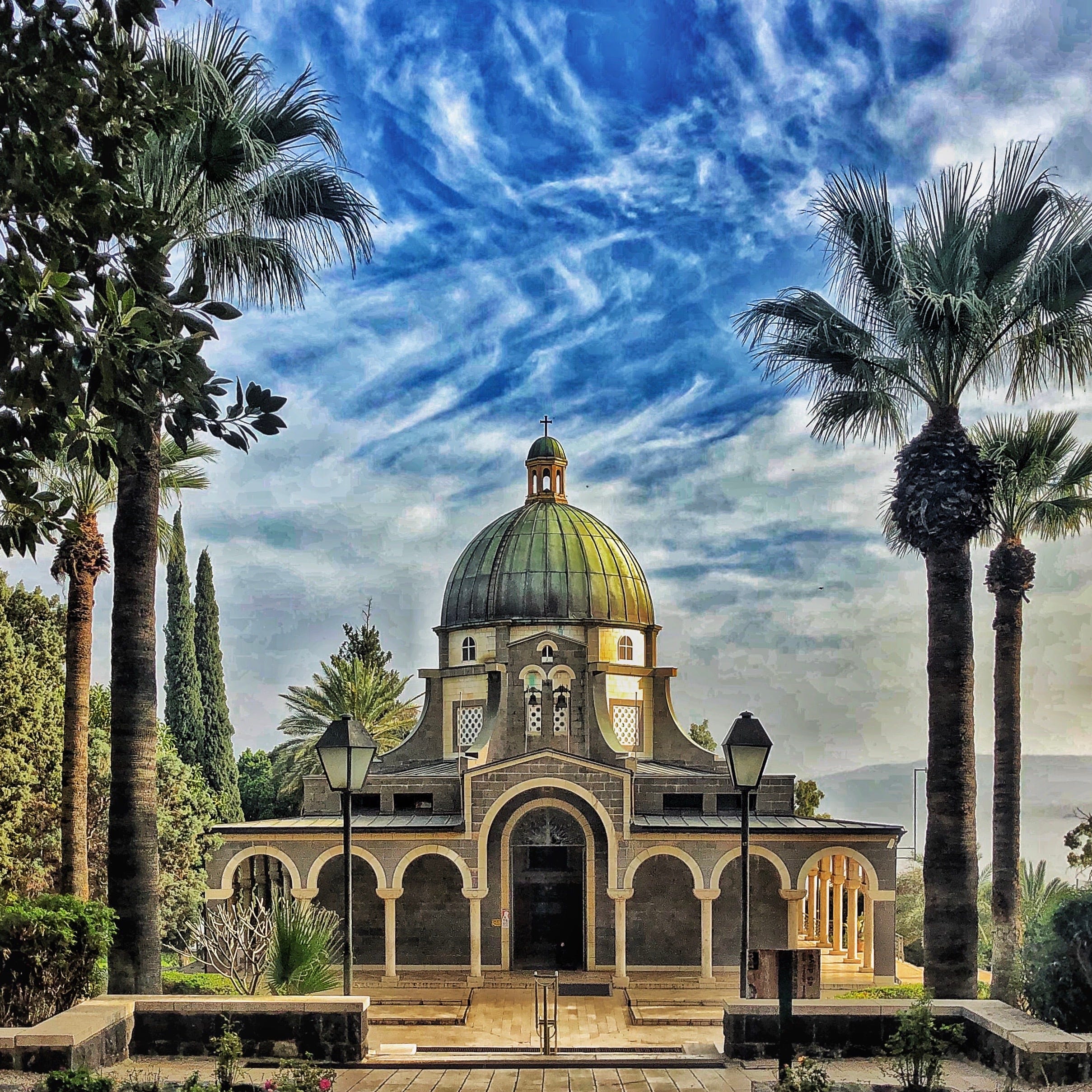
(The picture for this post is my own photo of the Franciscan chapel on the Mount of Beatitudes in Galilee. I took this picture on March 10, 2020, just as the world was shutting down and I had the whole place to myself.)
Our ethos (reflecting the beatitudes) should shape our politics … not the other way around. May we move to the “beat” of Jesus!
So very much appreciate the clarity and direction of this essay. Unfortunately, clarity of Christian ethos has been sadly “muddied” by the restrictive yet alluring politics of empire! When the ethos of empire compromise the ethos of Kingdom the Beatitudes of Jesus’ Sermon on the Mount become far less literal demands for
for living in a community of faith and instead take on an uncomfortable and most unattractive orthodoxy!